Welcome to the Newsletter May 2026
We can hardly believe we are already in May of this year, fast approaching the half way point of 2026. As always lots of exciting things happening throughout the month.
Vacancies
We’re excited to share that we have three new job openings for Dutch-speaking professionals! These roles are part of Esther Captain’s Tax Office and Customs project, offering a great opportunity to join KITLV. Applications are open until 31 May, so there’s still time to spread the word.
If you know any Dutch-speaking candidates who might be interested, we’d truly appreciate you sharing these opportunities within your network. Below you’ll find the job titles along with the application link.
Junior Onderzoeker ‘Het koloniale verleden van de Belastingdienst en Douane – Indonesië’:
PHD project ’Embodied knowledge of the past: Plantation Suriname and other cases’
Are you interested in researching colonial histories through embodied practices like dance, theatre, and music? This PhD project explores how artistic methods can help identify and process historical trauma, with a focus on Plantation Suriname and related cases.
You’ll work in a transdisciplinary team and collaborate with partners such as HERStory Art Foundation, Theater Thalia, and NAKS.
Who should apply:
Master’s graduates in Cultural Studies or related fields with an interest in colonial history, memory studies, and art-based research methods.
Where: Radboud University
Salary: €3,059–€3,881/month
Deadline: 6 May 2026
Upcoming Events
Re/Presenting Europe Hosts a Keti Koti Table on Belonging to Academia!
Date: 28 May 2026 Time:17:30 – 21:00 Location: Huis van Dialoog, Floraweg 200 1032 ZG
Please sign up here
Theme: Belonging to Academia Language: English


Africadelic 11th Edition is Here!
Amsterdam’s annual Africadelic festival will take place May 20-27 this year (2026). It centers May 25, International Africa Day, and brings the cultural creativity and diversity of African and African diasporic artists, creatives, and activists to the public. This year the program features a strong focus on film and a special emphasis on Ghana and the Caribbean
Check out the programme here
Past Events
Spheres of Belonging Workshop
On Monday 20th of April, researchers from Re/Presenting Europe and fellows from the NIAS came together to exchange perspectives, and share knowledge on Belonging, as a concept, practice, and (contested) goal. The workshop was grounded in an embodied performance by Farida Nabibaks, and a guided visualisation by Shivant Jhaggroe and it featured a presentation on positioned and community-engaged research practice by Jody Metcalfe and Jonathan Tjien Fooh. In the afternoon, we reflected on how these insights aligned with our own research and together visualised a ‘Belonging Manifesto’ – how academia could be adjusted to increase a sense of belonging. This workshop demonstrated the value of embodied understandings of belonging in knowledge work and acknowledged the challenges facing people from marginalised communities in academic settings.

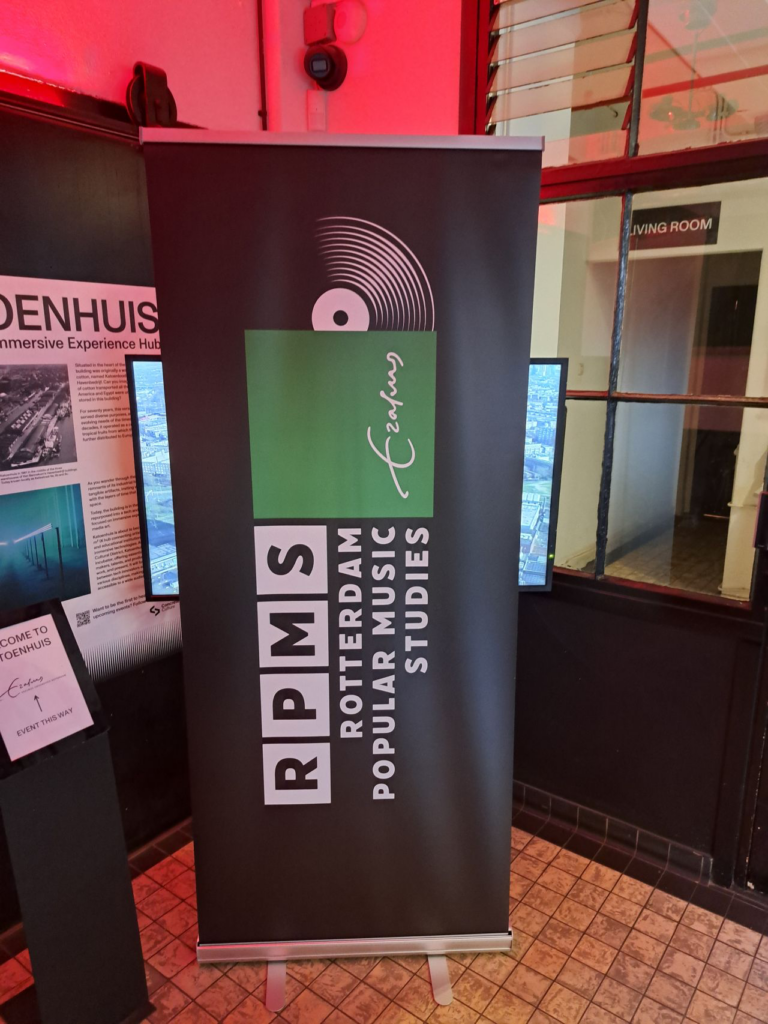
Rotterdam Popular Music Studies Conference: We Want More
Two days of our Rotterdam Popular Music Studies conference We Want More: Music / Sociology!
140 attendees, 89 papers, 15 young scholars, 3 locations – by academics from leading research institutions from across the world as well as researchers from Keychange, Live DMA, Boekmanstichting, and Podiumkunst.net.
Highlights include the feeling of community and solidarity among participants, meeting old friends and making new ones, and the quality of the presented work. Kim Dankoor was a key organiser and she and Rachel Gillett each gave presentations on their current research on Hip Hop.


Jan Willem Duyvendak Valedictory Lecture on Emotions and Politics
On April 24 Jan Willem Duyvendak gave his valedictory lecture marking his transition to Emeritus Professor, and his retirement from the position of Director of the Netherlands Institute for Advanced Study. The lecture and the symposium of which it was a part, were a celebration of his long and rich career. His lecture highlighted how emotions, especially those attached to the idea of “home”, have become central and increasingly divisive in political debates. These emotions are often tied to questions of belonging and exclusion. He argued that social tensions today stem as much from shifting power relations as diverse groups are better recognised and able to advocate for their needs. This can provoke perceptions of loss, and that is as much a factor in polarisation as growing inequality is, argued Jan-Willem. Duyvendak also stressed the importance of sociologists engaging with the public while staying grounded in research.
He adds further detail in this interview about the lecture.
At the end of the lecture Jan Willem was presented with the book Citizenship in Nativist Times which was commissioned for the occasion of his retirement and which features contributions inspired by his work. The volume brings together over 30 academics who collectively show that universities, academics, and scholarship have an essential role to play in periods of democratic and rule-of-law erosion, not only in producing knowledge, but in sustaining the moral, civic, and institutional conditions of a free society.


 Previous Post
 Next Post