Re/Presenting Europe Blog
ONS LAND: Unsilencing Postcolonial Migration
Written by Irene Bouwman – Edited by Isabella Hall Allen & Rachel Gillett
The Netherlands has had a long and complex (post)colonial involvement with Indonesia. Yet if you asked passersby on the street, public awareness of the events of Indonesian (post)colonial history remains limited. Museum Sophiahof and the Indisch Herinneringscentrum are aiming to change that. They do so by placing personal stories at the centre of public conversations and exhibitions that illuminate these complicated histories.
Colonial society
Those stories begin with context. In the late colonial period in the Dutch East Indies, society was highly structured around perceptions of ‘race’ and Dutchness. The population was divided into three hierarchal legal statuses: Europeanen (‘Europeans’), Vreemde Oosterlingen (‘Foreign Orientals’), and Inlanders (‘Natives’). These categories seemed to signify clear racial distinctions, dividing society along physical traits. However, these signifiers were not clear-cut, as these racial lines could be crossed, allowing social mobility between groups.[1] A prime example of the complexity of the legal hierarchy in this colonial society is the presence of a distinct ‘crossover’ group of Indo-Europeans: people of both Dutch and Indonesian descent who could be either categorised as Europeanen or Inlander, based on social and cultural factors.[2] Still, it is important to know that these categories were structured to institutionally favour lighter-skinned people and Dutch culture in determining who was declared ‘Europeaan.’ People who migrated to the Netherlands from this complex colonial society were from various ethnic and cultural backgrounds, within a broad Indonesian heritage.
Postcolonial migration
As Dutch colonial rule ended, the hierarchies that upheld a system that benefitted people of Dutch descent collapsed. After the Japanese occupation of the Dutch East Indies and the proclamation of independent Indonesia, a period of postcolonial migration from the Dutch East Indies to the Netherlands thus began. Indonesia was hostile towards Europeanen and many opted to ‘return’ to ‘the motherland’. From 1945 until the end of the 1960s, approximately 300,000 people migrated to the metropole. This migration peaked in the 1950s, when relations between the Netherlands and Indonesia worsened.
Although postcolonial migrants came from various social and cultural backgrounds, they felt connected by their shared experience as migrants in the Netherlands. They had all travelled to a largely foreign country, and most felt like second-class citizens at some point.[3] Moreover, they shared a common cultural denominator: an affinity with Dutch culture. Aside from their legal Dutch citizenship, both ethnically Dutch and Indisch people spoke Dutch and were often Christian. This shared experience led them to identify as a collective group of ‘Indische Nederlanders’, highlighting their foreign origin and shared experience.
These Indische Nederlanders did not receive quite the warm welcome they had hoped. The Dutch government received them with ambivalence. They suffered from stigmatisation and discrimination, and for a period were even encouraged to give up their Dutch identity and take on Indonesian nationality. Only when the Indonesian government actively barred Dutch citizens from residing in Indonesia, leaving these people with no other homeland, did the Dutch government change its attitude. Despite these negative experiences, the repatrianten (‘returnees’) were encouraged to ‘integrate’: the Dutch government, churches and welfare workers assisted them with housing, schooling and work, with these systems staying in place until the 1970s. As a result, their assimilation was viewed as a success and described as ‘silent integration’.
One group had a different experience: the Moluccans. Approximately 4,000 soldiers and their families travelled to the Netherlands, initially to stay for a short term before returning to their homeland, but this return never occurred. As both the Dutch government and the Moluccan community viewed their stay as temporary, their integration was not as encouraged as that of the Indische Nederlanders. Living in closed communities, they remained far more segregated and experienced greater friction within Dutch society.[4]
Museum Sophiahof
Unfortunately, these histories still receive little attention in school curricula, and public historical discussion, and thus are not well-known to a broad Dutch public. Museum Sophiahof aims to address that absence in its exhibition ONS LAND. This semi-permanent exhibition, curated by the Indisch Herinneringscentrum and Museum Maluku, tells the history of postcolonial migrants through the personal stories of eight families, stretching across generations. Margaret Leidelmijer, coordinator of the knowledge centre and exhibitions, co-curated the exhibition. They deliberately put the families’ personal stories at the core. Where previous exhibitions told the ‘big story’ with personal stories as illustration, they chose to do it the other way around. The exhibition highlights families from a variety of cultural/ethnic backgrounds, arriving in the Netherlands at different moments in time. For Leidelmijer, this diversity is characteristic of the history:
“The Indonesian community is so diverse, […] it’s almost impossible to define. The only thing they have in common, I think, is that they’ve come from Indonesia to the Netherlands.”
Through lengthy interviews, the families themselves chose what they deemed important to discuss, resulting in a multi-layered perspective in the exhibition.
“When you hear what people say, about what they’ve been through, what decolonisation has meant to them, you get a much stronger sense of … it hits much closer to home.”
ONS LAND is intended for a wide audience and has a dual goal: recognition for the communities themselves and acknowledgement by the wider audience. As Leidelmijer explains, “[a]n exhibition like this actually provides a very accessible introduction to that incredibly intricate and complex history”, aiming to instigate both empathy and recognition in its visitors. Beyond the exhibition’s visibility, they are also deeply involved in education, one of the broader pillars of ONS LAND. This educational role was initiated by the community of postcolonial migrants themselves, who believed that the colonial history of the Dutch East Indies should have a more prominent place in the Dutch education system. Through teaching materials, videos and teacher tutorials, ONS LAND is at the forefront of changing attitudes within history education, something that has merely started.
Although Indonesian (post)colonial history is still often ignored in public historical knowledge, Museum Sophiahof and the Indisch Herinneringscentrum show how we can spark important conversations around these topics, with personal stories at the centre of our understanding of the past.
“I just hope that this really does turn out, as intended, to be a haven for the postcolonial community.”
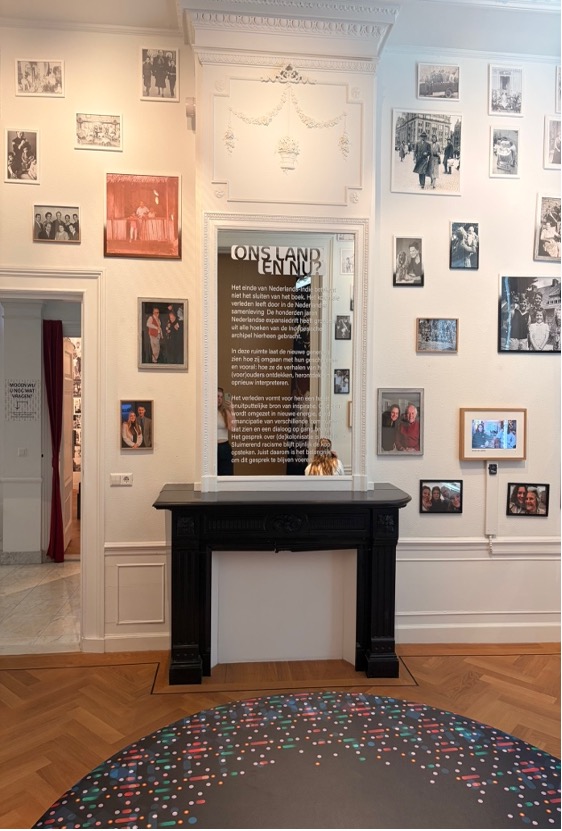
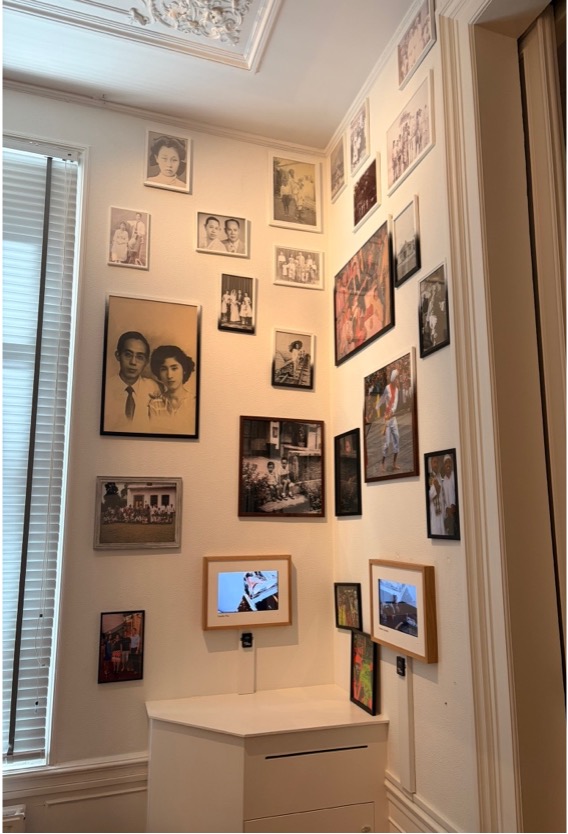
ONS LAND exhibition, final room. Collection of personal photos and interview snippets of the families that are highlighted in the exhibition. Own photo taken on May 1st, 2026.
[1] For a brief summary on debates surrounding social hierarchies in the Dutch East Indies, see Susie Protschky, ‘Race, class, and gender: Debates over the character of social hierarchies in the Netherlands Indies, circa 1600–1942’ Bijdragen tot de taal-, land- en volkenkunde / Journal of the Humanities and Social Sciences of Southeast Asia 167, no. 4 (2011): 543-556.
[2] See for example Bart Luttikhuis, ‘Beyond race: constructions of ‘Europeanness’ in late-colonial legal practice in the Dutch East Indies’ European Review of History—Revue européenne d’histoire 20, no. 4 (2013): 539-558.
[3] Ulbe Bosma, ‘Introduction: Post-colonial immigrants and identity formations in the Netherlands’ in Post-Colonial Immigrants and Identity Formations in the Netherlands, eds. Ulbe Bosma (London: Routledge, 2012), see 16-17.
[4] For a more in-depth explanation Moluccan migration to the Netherlands see Hans van Amersfoort and Mies van Niekerk, ‘Immigration as a Colonial Inheritance: Post-Colonial Immigrants in the Netherlands, 1945-2002’ Journal of Ethnic and Migration Studies 32, no. 3 (2006), see 329-333.